Snorkeling with Sharks in Moorea — Complete Safety Guide (2026)
Moorea has some of the most reliable shark snorkeling in the world — blacktip reef sharks at the inner lagoon sandbar, lemon sharks outside the barrier reef, and the occasional spotted eagle ray as a bonus. If you are planning to snorkel in Moorea and are wondering about the sharks, this guide covers everything: which species you will encounter, whether they are dangerous, the best spots and tours, and what the guides expect of you in the water.
Which Sharks Can You See Snorkeling in Moorea?
Moorea's lagoon and nearby reef host several shark species regularly encountered by snorkelers. The two most common are the blacktip reef shark (present on virtually every snorkeling tour) and the lemon shark (found at the outer barrier reef).
- Blacktip reef shark (Carcharhinus melanopterus): the most common shark in Moorea's lagoon — 0.8–1.2 m, easily identified by black fin tips, present at all main snorkeling sites
- Lemon shark (Negaprion brevirostris): larger (1.5–2.5 m), found at the outer barrier reef and passes — less frequent but regular
- Whitetip reef shark: occasionally seen resting on the seabed near coral formations
- Spotted eagle ray: not a shark but often mentioned alongside them — occasional sighting at the outer reef
- Nurse shark: sometimes seen resting under coral ledges in the deeper lagoon sections
Blacktip Reef Sharks — The Resident Sharks of Moorea's Lagoon
Blacktip reef sharks are the defining wildlife encounter of Moorea snorkeling — present at the stingray and shark sandbar at Hauru, around Coral Garden Tiahura, and at the outer reef. They are slender, fast-moving sharks that cruise along the reef edge and the sandy lagoon floor, typically at 3–8 feet depth at the sandbar. At the sandbar, they are so habituated to snorkelers that they swim within arm's reach — the guides enforce a strict no-touching rule to keep both sharks and guests safe.
At the outer barrier reef, they are seen at greater depth, often below the snorkeling group.
Lemon Sharks — The Outer Reef Encounter
Lemon sharks are encountered at the barrier reef pass near Tiahura during tours that venture outside the lagoon. They are larger than blacktips and typically spotted at 60–80 feet depth below the snorkeling group, cruising along the reef wall. Guides enter the water first to check conditions and lead the group along the outer wall at a safe distance.
Lemon sharks in Moorea have shown no aggression toward snorkelers in decades of guided tours.
Is It Safe to Snorkel with Sharks in Moorea?
The short answer: yes. Blacktip reef sharks and lemon sharks in Moorea's lagoon and reef are not aggressive toward snorkelers under normal conditions. The longer answer requires understanding what 'normal conditions' means — and why the guides' rules are not optional.
- No recorded attacks: no snorkeler has been bitten by a shark in Moorea's guided tour areas in the modern tour history
- Habituated sharks: the sharks at the Hauru sandbar are fully accustomed to human presence after years of daily tours
- Guides manage the encounters: every licensed tour operator leads shark snorkeling under a strict code of conduct
- Key rule: no touching marine life — fingers in the sand or too close to a feeding stingray is the most common source of accidental contact
Safety Rules That Guides Enforce
Every snorkeling guide in Moorea enforces the same core rules during shark encounters. These are not suggestions — guides will ask guests to return to the boat if rules are repeatedly ignored.
- No touching: sharks, stingrays, sea turtles, and coral are not to be touched under any circumstances
- No chasing: do not pursue a shark that is moving away from the group
- No erratic movement: sudden splashing or diving toward sharks is not permitted
- Stay with the group: do not swim away from the guide at shark encounters
- No feeding: bringing food into the water disrupts shark behaviour and is prohibited
Should You Be Nervous Before a Shark Snorkeling Tour?
Being nervous before your first shark snorkeling experience is completely normal. The guides understand this and almost all tour reviews mention how quickly nervous guests relax once they are in the water — often within minutes of entering, once they see how the blacktip sharks simply ignore the group and go about their business. The experience of watching a shark cruise past at 2–3 metres is one of the most commonly cited highlights across all Moorea snorkeling reviews.
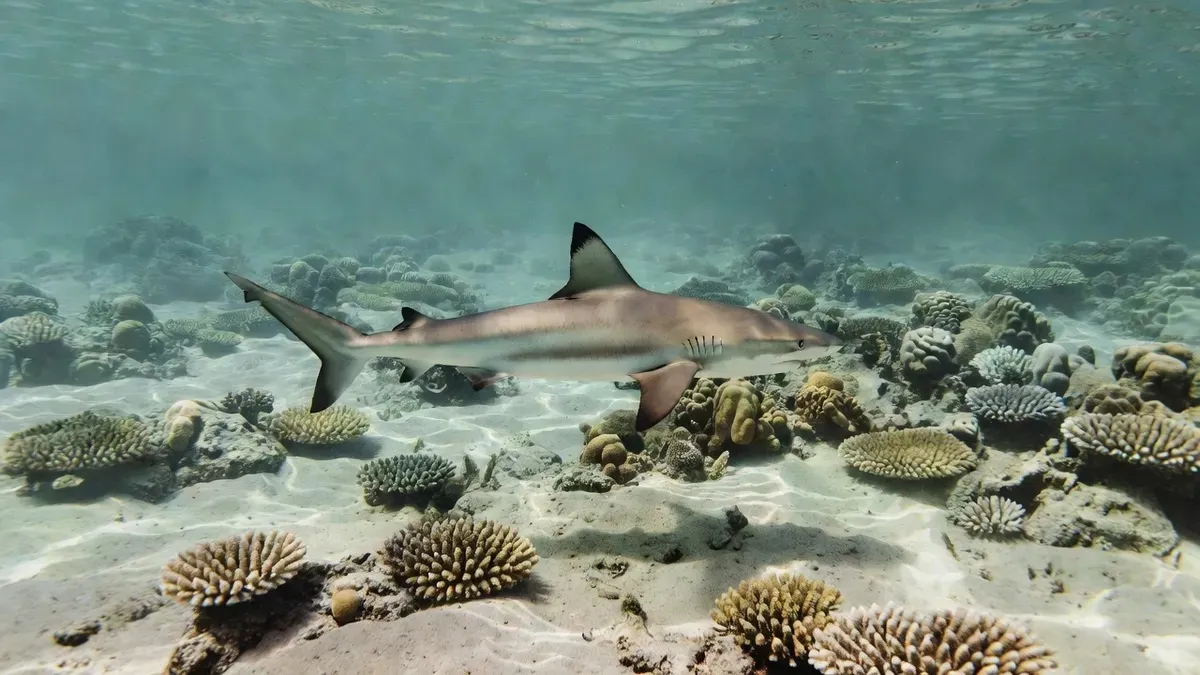
Blacktip reef sharks at the Hauru sandbar — the most reliable shark encounter in Moorea, seen on virtually every guided tour departure.
Best Spots and Tours for Shark Snorkeling in Moorea
Hauru Stingray and Shark Sandbar — Most Accessible
The Hauru sandbar (near PK 27 on the northwest coast) is Moorea's most visited shark snorkeling spot — a shallow, white sand flat 2–4 feet deep where blacktip reef sharks and Pacific stingrays congregate reliably every day. The water is calm, the sharks are accustomed to visitors, and the shallow depth means that standing is possible if you feel uncertain at any point. Every guided snorkeling tour in Moorea includes the sandbar as a stop.
This is the best spot for first-time shark snorkelers.
- Water depth: 2–4 feet — you can stand at any time
- Sharks: blacktip reef sharks (0.8–1.2 m)
- Access: by guided tour from any northwest coast operator
- Best tour: ENJOY BOAT TOURS MOOREA lagoon and reef snorkeling tour or AKIVAI floating lounge tour
Outer Barrier Reef (Tiahura Pass) — Most Dramatic
The barrier reef pass near Tiahura is where lemon sharks are encountered — in open water at 60–80 feet depth. This stop is only accessible on tours that go outside the reef (the ENJOY BOAT TOURS MOOREA lagoon and reef tour is the main option). The outer reef is not suitable for nervous snorkelers — the open-ocean environment, deeper water, and stronger current require confidence.
For experienced snorkelers, the outer reef pass is the most exciting wildlife encounter available in Moorea.
- Water depth: 20–80 feet at the reef wall
- Sharks: lemon sharks (1.5–2.5 m) + blacktips
- Access: ENJOY BOAT TOURS MOOREA lagoon and reef tour only
- Requirements: comfortable in open water, confident swimmer
Which Tours Include Shark Encounters?
All six guided snorkeling tours in Moorea include shark encounters at the sandbar or reef as part of the circuit. The difference is the depth and intensity of the encounter.
- ENJOY BOAT TOURS MOOREA lagoon and reef snorkeling tour: sandbar + outer reef lemon sharks — most comprehensive shark circuit
- Moorea Sea Experience small group snorkeling tour: sandbar + outer reef drop-off — 6 guests, intimate encounter
- Ariki Tours whale swimming and snorkeling tour: sandbar sharks + open ocean (stingrays, turtles, dolphins)
- TOREA NUI lagoon canoe tour: stingray and shark sandbar on the east-side circuit
- Moorea Water Games sea scooter snorkeling tour: marine life zone with stingrays and blacktips
- AKIVAI luxury floating lounge snorkeling tour: stingray and shark zone from the comfort of the lounge platform
Frequently Asked Questions About Moorea Shark Safety
Do I Need to Be a Strong Swimmer?
For the Hauru sandbar shark encounter: no — the water is 2–4 feet deep and guides support nervous guests. For the outer barrier reef encounter: yes — open water swimming confidence is required. If you are not a strong swimmer but want to see sharks, the AKIVAI floating lounge tour and the ENJOY BOAT TOURS MOOREA standard lagoon and reef tour both include the sandbar and cater to nervous guests.
What Happens if a Shark Swims Directly Toward Me?
Stay calm and hold your position — do not splash or turn and swim away rapidly. Guides watch for this exactly. Blacktip reef sharks investigating a snorkeler typically turn away at 1–2 metres and rejoin the group near the sandbar.
The reflex to kick and splash at an approaching shark is the single most counterproductive response — it signals distress or prey behaviour. Guides will brief you on exactly what to do before you enter the water.
Moorea Shark Snorkeling — FAQ
Are the sharks dangerous in Moorea?
No — blacktip reef sharks and lemon sharks in Moorea are not dangerous to snorkelers when standard safety rules are followed. Blacktip reef sharks (the most common species at the sandbar) are small (0.8–1.2 m), non-aggressive, and fully habituated to human presence. Lemon sharks (outside the barrier reef) are larger but equally docile when approached calmly. There are no recorded shark attack incidents in Moorea's guided tour areas.
How close will I get to the sharks?
At the Hauru sandbar, blacktip reef sharks typically cruise within 1–3 metres of the snorkeling group. They are accustomed to daily tour visitors and do not keep any particular distance from snorkelers who are calm and stationary. Some guests report sharks passing within touching distance — which is why the no-touching rule is both safety-critical and strictly enforced. At the outer reef, lemon sharks are usually seen at 5–15 metres depth below the group.
Can children snorkel with sharks in Moorea?
Yes — at the Hauru sandbar, the 2–4 foot depth makes shark snorkeling accessible to children. Operators specify age minimums that vary by tour: most accept children from age 8–10 with a parent present. The Moorea Water Games sea scooter tour explicitly accepts children from age 8 and the sea scooter removes the swimming requirement. Parents should supervise children closely at all shark encounters and brief them on the no-touching rule before entering the water.
Do I need to pay extra for shark snorkeling?
No — shark encounters are included in the standard price of all Moorea snorkeling tours. There is no premium add-on for the shark stops. The shark sandbar is a core stop on every tour circuit at no additional charge. The outer reef shark encounter (lemon sharks) is included in the ENJOY BOAT TOURS MOOREA lagoon and reef tour at the standard per-person price of $116.
What is the difference between snorkeling with sharks on a tour versus independently?
The Hauru sandbar is accessible by boat (guided tour) but not easily by shore — the sandbar is offshore and requires a boat to reach efficiently. Independent snorkeling at sites like Temae Beach may produce blacktip shark sightings on the reef, but the dedicated sandbar encounter is a tour-only experience. For safety at the outer reef, a guide is essential — the current outside the barrier reef requires experience to navigate safely, and the encounter itself requires a guide to lead the group correctly.